 Post by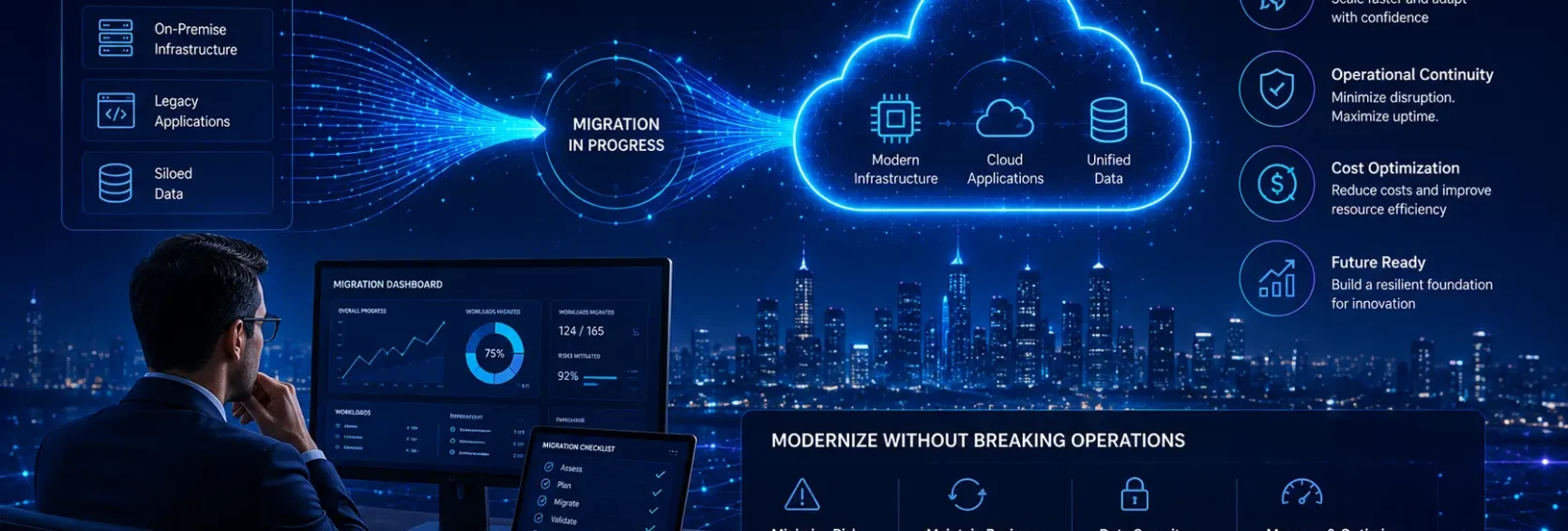
For years, many businesses delayed modernization because the risk felt bigger than the reward. Legacy systems were deeply connected to operations. Data lived across multiple environments. Teams relied on old workflows that technically still worked — even if they slowed growth, reduced visibility, and created operational friction every day. But in 2026, that hesitation is becoming expensive. Businesses are now under pressure to move faster, integrate smarter systems, improve scalability, and reduce infrastructure complexity. And that shift is pushing organizations toward large-scale B2B migration initiatives.
At CCPL.AI, we help businesses modernize systems without disrupting the operations they depend on every day from ERP and CRM migration to cloud infrastructure modernization, data migration, and enterprise workflow transformation. Because successful migration is not just about moving systems. It’s about moving businesses forward safely.
TL;DR
- B2B migration helps businesses modernize systems, infrastructure, and operations.
- Legacy systems create scalability, security, and integration challenges.
- Cloud migration and ERP modernization are accelerating in 2026.
- Successful migration requires planning, governance, and operational continuity.
- Businesses modernizing early are creating long-term operational advantages.
What Are B2B Migration Services?
B2B migration services help organizations modernize business systems, move operational infrastructure, transfer enterprise data, and upgrade workflows without disrupting daily operations.
These services often include:
• Data migration
• ERP migration
• CRM migration
• Cloud migration
• Legacy system modernization
• Infrastructure transformation
• Application migration
Modern migration projects focus not only on technology upgrades, but also on improving scalability, operational efficiency, security, and long-term business flexibility.
Why Businesses Are Moving Away From Legacy Systems
Many organizations still rely on systems built years – sometimes decades – ago. The challenge is that older systems were never designed for modern business speed, cloud scalability, AI integration, or real-time analytics. As companies grow, these limitations become harder to ignore.
Legacy infrastructure often creates:
• Slow workflows
• Data silos
• Expensive maintenance costs
• Integration limitations
• Security vulnerabilities
• Poor scalability
What once felt stable eventually becomes a barrier to growth. That is why enterprise modernization has become a strategic priority across industries in 2026.
Cloud Migration Is Accelerating Across Industries
Cloud migration continues to be one of the biggest priorities for enterprise technology teams. Businesses are moving applications, databases, analytics systems, and operational workloads into cloud environments to improve flexibility and reduce infrastructure complexity.
The advantages are significant:
• Better scalability
• Faster deployment cycles
• Improved disaster recovery
• Lower infrastructure maintenance
• Stronger remote accessibility
• Easier AI and analytics integration
But cloud migration also introduces challenges around security, governance, performance optimization, and operational continuity. That’s why successful migration requires careful architecture planning rather than rushed implementation.
ERP & CRM Migration: The Backbone of Modern Operations
ERP and CRM systems are deeply connected to daily business operations. When businesses migrate these platforms, they are not simply replacing software – they are reshaping workflows, reporting structures, operational visibility, and customer management processes.
Modern ERP and CRM migration projects often focus on:
• Centralized data visibility
• Real-time reporting
• Better automation
• Workflow standardization
• Cross-department collaboration
• Improved scalability
The organizations handling these transitions successfully usually prioritize process alignment alongside technical implementation.
Why Data Migration Is More Complex Than Most Companies Expect
Data migration sounds simple in theory. Move data from one system to another. But in reality, enterprise data environments are often fragmented, inconsistent, duplicated, and deeply connected to operational processes.
Migration projects frequently involve:
• Data cleansing
• Data mapping
• Validation testing
• Security governance
• Compliance requirements
• Downtime risk management
Poorly planned migration can create reporting failures, operational interruptions, and customer experience issues. That’s why experienced migration teams focus heavily on planning, governance, and validation before moving production systems.
The Biggest Risks in B2B Migration Projects
Many migration initiatives fail because businesses underestimate operational complexity.
Some of the most common migration risks include:
• Data loss
• Extended downtime
• Broken integrations
• Security vulnerabilities
• Workflow disruption
• Employee adoption resistance
• Poor rollback planning
Successful migration projects reduce risk through phased implementation, testing environments, governance frameworks, and continuous monitoring.
“The best migration projects feel invisible to customers while transforming operations internally.”
How Smart Businesses Approach Migration in 2026
The businesses succeeding with modernization projects are taking a strategic approach.
Instead of rushing large-scale transformations all at once, they focus on:
• Business continuity
• Risk management
• Data governance
• Scalable architecture
• Operational alignment
• Future-ready infrastructure
Modern migration is no longer just an IT project.
It is a business transformation initiative tied directly to scalability, operational efficiency, analytics capability, and long-term competitiveness.
Industries Accelerating B2B Migration Initiatives
Migration demand is increasing across nearly every industry. Healthcare organizations are modernizing compliance and patient systems. Financial companies are upgrading infrastructure for security and analytics. Retail businesses are migrating toward cloud-native commerce operations. Manufacturers are integrating IoT and predictive analytics platforms. Across sectors, the goal remains the same:
Build systems capable of supporting modern business speed and data-driven operations.
The Future of Enterprise Modernization
Enterprise modernization will continue accelerating as businesses adopt AI, cloud infrastructure, predictive analytics, and automation systems. The companies building flexible infrastructure today will adapt faster tomorrow. At CCPL.AI, we help organizations modernize with confidence – from B2B migration and cloud transformation to ERP modernization, data engineering, and intelligent enterprise systems. Because migration is not just about replacing old technology. It’s about building a stronger operational foundation for future growth.