 Post by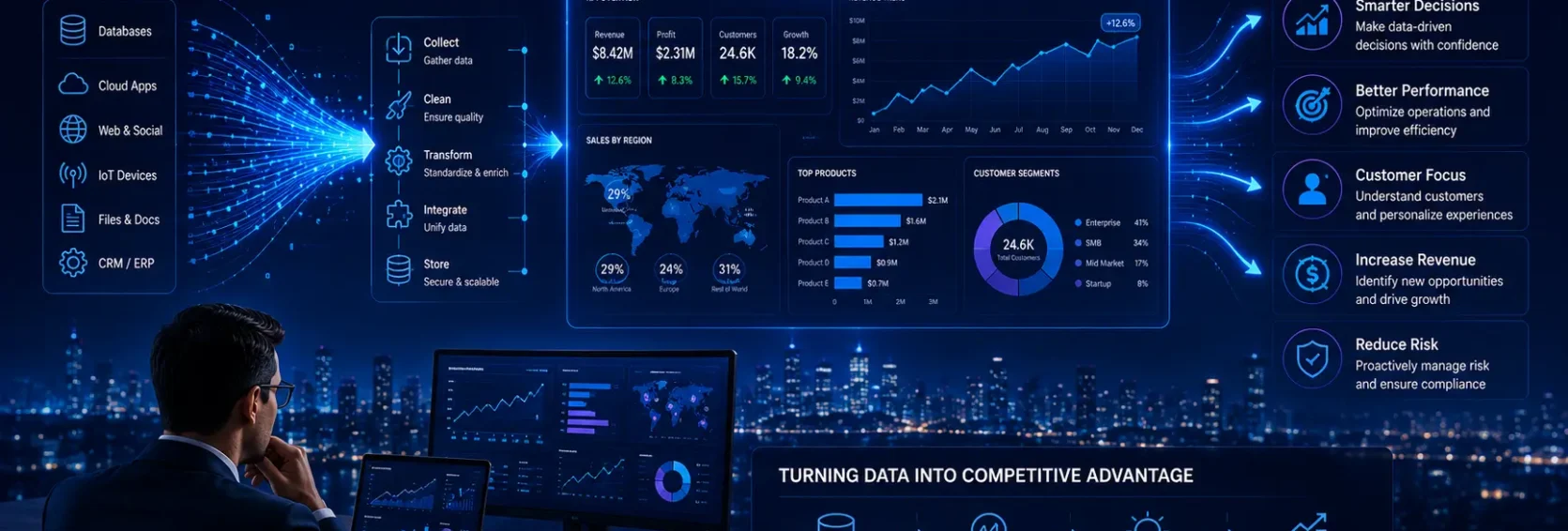
Most businesses are not struggling because they lack data. They are struggling because they cannot turn that data into clear decisions quickly enough.
Every day, companies generate enormous amounts of operational information – customer interactions, sales activity, inventory movement, marketing performance, financial transactions, support tickets, logistics updates, and behavioral insights.
But without the right analytics systems, most of that information stays disconnected, underused, or trapped inside dashboards nobody truly acts on. That is why data analytics has become one of the most important business capabilities in 2026.
At CCPL.AI, we help organizations transform raw business data into operational intelligence that improves forecasting, decision-making, efficiency, and long-term growth. Because data only creates value when businesses know how to use it effectively.
TL;DR
- Data analytics helps businesses make faster and smarter decisions.
- Predictive analytics is becoming a major competitive advantage.
- Modern analytics systems improve operational visibility and forecasting.
- Businesses are moving beyond dashboards toward real-time intelligence.
- Strong data infrastructure is critical for scalable analytics.
What Are Data Analytics Services?
Data analytics services help businesses collect, organize, analyze, and interpret data to improve operational performance and strategic decision-making.
These services often include:
• Business intelligence dashboards
• Predictive analytics
• Data visualization
• Reporting automation
• Customer behavior analysis
• Real-time analytics
• KPI tracking systems
• Data warehousing
Modern analytics systems help organizations move beyond static reports toward actionable operational intelligence.
Why Data Analytics Matters More Than Ever in 2026
Businesses today operate in environments that change quickly. Customer expectations evolve rapidly. Supply chains shift unexpectedly. Market conditions fluctuate constantly.
The companies adapting fastest are usually the ones making decisions based on data rather than assumptions. Modern analytics platforms help organizations identify operational trends earlier, respond faster to business risks, and uncover opportunities competitors often miss. That operational visibility creates a major competitive advantage.
From Raw Data to Unified Business Intelligence
One of the biggest challenges businesses face is fragmented data. Sales systems, ERP platforms, customer databases, marketing tools, and operational software often operate independently. That creates disconnected reporting and inconsistent decision-making.
Modern data analytics focuses heavily on creating unified data environments where organizations can access accurate information across departments in real time. Unified business intelligence improves collaboration, forecasting accuracy, and operational clarity.
Predictive Analytics Is Changing Business Strategy
Traditional reporting explains what already happened. Predictive analytics helps businesses anticipate what happens next. Machine learning and advanced analytics models can identify patterns that help organizations forecast demand, predict customer churn, identify operational risks, and optimize resource planning.
Retail companies use predictive analytics for inventory forecasting. Financial organizations use it for fraud detection and risk assessment. Manufacturers use predictive systems for maintenance planning and operational optimization. The businesses using predictive analytics effectively are moving from reactive operations toward proactive strategy.
AI-Powered Analytics Is Transforming Decision-Making
Artificial intelligence is changing how analytics systems operate. AI-powered analytics platforms can automatically identify trends, detect anomalies, generate recommendations, and surface insights faster than traditional reporting systems. Instead of manually searching through dashboards, business teams increasingly rely on intelligent analytics systems that prioritize actionable insights automatically. This shift is reducing reporting delays and helping leadership teams make decisions with greater speed and confidence.
Why Dashboards Alone Are No Longer Enough
Many businesses invested heavily in dashboards over the past decade. But dashboards alone do not guarantee better decisions. Without context, forecasting, and operational alignment, dashboards often become passive reporting tools rather than active business intelligence systems.
The next generation of analytics focuses on:
• Real-time visibility
• Automated insights
• Predictive recommendations
• Cross-functional intelligence
• Operational actionability
Businesses now expect analytics systems to support decisions — not simply display information.
Common Data Analytics Challenges Businesses Face
Many organizations struggle with analytics because their infrastructure was never designed for modern data complexity.
Common challenges include:
• Data silos
• Poor data quality
• Inconsistent reporting
• Slow dashboards
• Lack of governance
• Limited scalability
• Disconnected systems
Successful analytics transformation requires strong data engineering, governance frameworks, and scalable architecture.
Industries Accelerating Analytics Investments
Data analytics adoption is growing rapidly across industries. Healthcare organizations use analytics for patient outcomes and operational efficiency. Retail companies optimize inventory and customer personalization. Financial businesses improve fraud detection and risk analysis. Manufacturing companies use analytics for predictive maintenance and supply chain optimization. Across industries, analytics is becoming a core operational capability rather than a secondary reporting function.
How Smart Businesses Approach Analytics in 2026
The businesses gaining the most value from analytics are taking a strategic approach. Instead of building isolated reporting systems, they focus on creating integrated intelligence ecosystems connected to operations, forecasting, customer experience, and leadership decision-making.
That includes:
• Real-time reporting systems
• Unified data pipelines
• AI-powered analytics
• Predictive forecasting
• Operational automation
• Data governance frameworks
The goal is not simply more data. The goal is better business decisions.
The Future of Data Analytics
The future of data analytics will revolve around automation, AI integration, predictive intelligence, and operational scalability. Businesses that build strong analytics foundations today will adapt faster to market changes tomorrow. At CCPL.AI, we help organizations transform raw business data into actionable intelligence through advanced analytics systems, business intelligence solutions, predictive modeling, data engineering, and AI-powered reporting platforms. Because in modern business, the companies understanding data fastest often move ahead fastest.